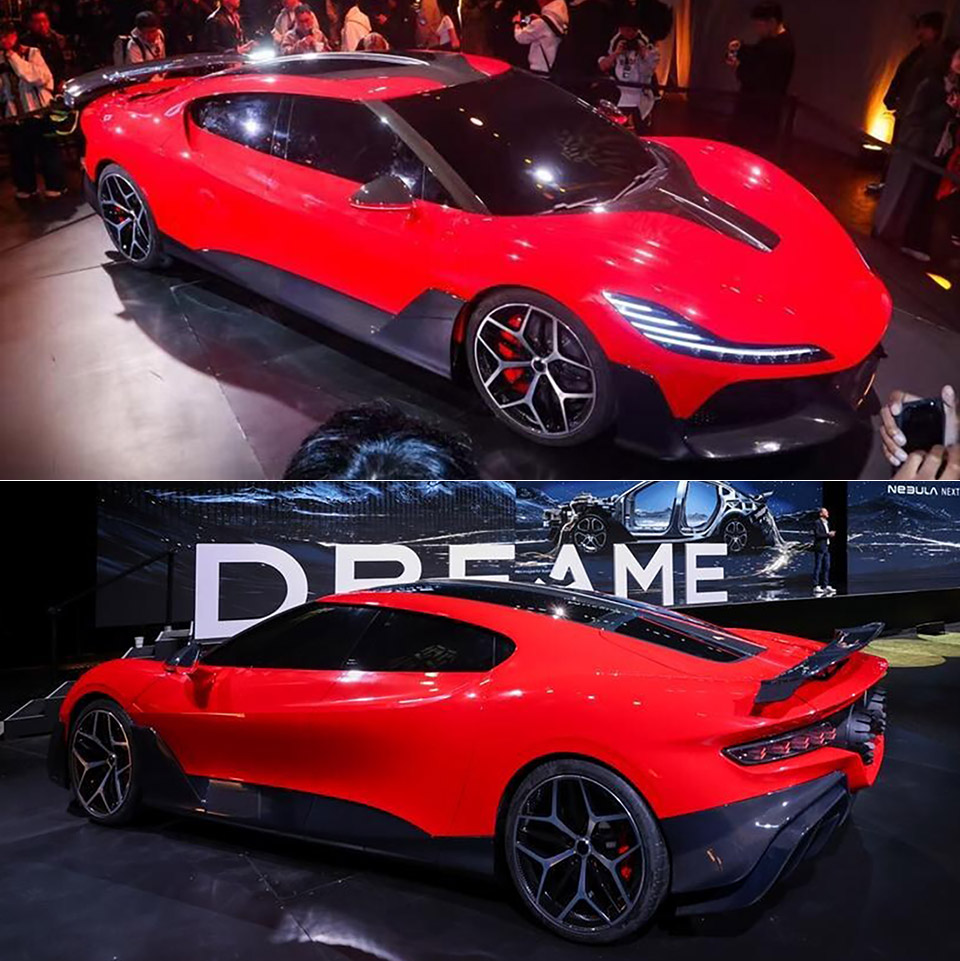
Engineers at Dreame, a Chinese company known for its robot vacuums and hair dryers, chose San Francisco for the American debut of the Nebula NEXT 01 Jet Edition. They parked their five-seat fastback on stage and let the truly amazing figures do the talking. Two solid rockets mounted on the back produce an amazing 100 kilonewtons of thrust in 150 milliseconds flat. That’s in addition to an electric powertrain that produces 1,876 horsepower as standard, with the Jet Edition delivering around 2,000 horsepower.
They built the entire vehicle around a cutting-edge wire-controlled technology that allows it to move in 14 different directions. They also included some ingenious technology, such as electromagnetic active suspension to keep the body stable during high-speed launches and dry brake-by-wire calipers to reduce drag and energy consumption by more than half. As a result, the car can do some very quick bends, or even stabilize itself if a tire blows out at high speed, and with a turning radius of just under five meters, drivers can whip the car around tiny areas without sacrificing any straight-line stability at all.
Sale

roborock Q7 M5+ Robot Vacuum and Mop, Upgraded from Q5 Max+, Up to 7-9 Weeks Self-Empty, 10000Pa Suction…
- 7-Weeks Hands Free Cleaning: With a 2.7L sealed dust bag, the RockDock Plus efficiently collects pet hair, dirt, and debris without the need for…
- 10000Pa HyperForce Suction Power: High-performance suction lifts pet hair and debris from every surface, reaching deep into carpets and along edges…
- Dual Anti-Tangle Design: Spend less time detangling and more time enjoying your day. The JawScrapers main brush and 0% hair-tangling side brush resist…
The drivetrain is fueled by high-performance solid-state sulfide batteries. Each cell contains 60 ampere-hours and has an energy density of more than 450 watt-hours per kilogram, values that have only increased in lab tests, with the ultimate goal of reaching 800. They applied a protective coating to the electrolyte and a specific layer to the sulfur cathode to prevent gas buildup and keep the batteries from overheating. That still gives the car a reasonable range of 342 miles on the Chinese test cycle, which is more than adequate for real-world driving whenever it advances beyond the concept stage. The first production versions are scheduled to roll off the lines in China in 2027, with a facility near Berlin following soon after.
The rockets are located exactly where a license plate would normally be, which is a good idea because this car is billed as a performance demonstrator rather than something you’d drive on the street. The gasoline tanks can be swapped out in minutes, allowing owners to perform a variety of outrageous stunts on salt flats and confined courses. To ensure the system is nice and steady, the designers made sure the two boosters stayed within a five percent variation of each other to prevent undesirable yaw. You can activate the system at any speed, but the biggest advantage is in the first second, when the tires just cannot cope with the electric force. The stats are pretty mind-blowing: 0.9 seconds to 62 mph, 100 kilonewtons of more power, and a battery that refuses to overheat even under harsh conditions. So the rest of the industry now has a new standard to strive toward.
The exterior is sized similarly to a BMW i7 in terms of length and wheelbase, however this vehicle sits 6 1/2 inches lower and is 3 1/2 inches wider. Four inboard mounted electric motors drive all four wheels with single speed gearing; no complicated gears here. Four motors also enable very fine torque control, allowing you to parallel park without moving forward. A high-end ‘DHX1’ 4k color LiDAR unit provides a 2,000-foot view of the road ahead and can detect small animals from 900 feet away, even in the rain or at night. Then there’s Metis, Dreame’s onboard AI system that predicts what the driver will want to do before they do it, coordinating the entire vehicle from the cockpit to the suspension.
[Source]
