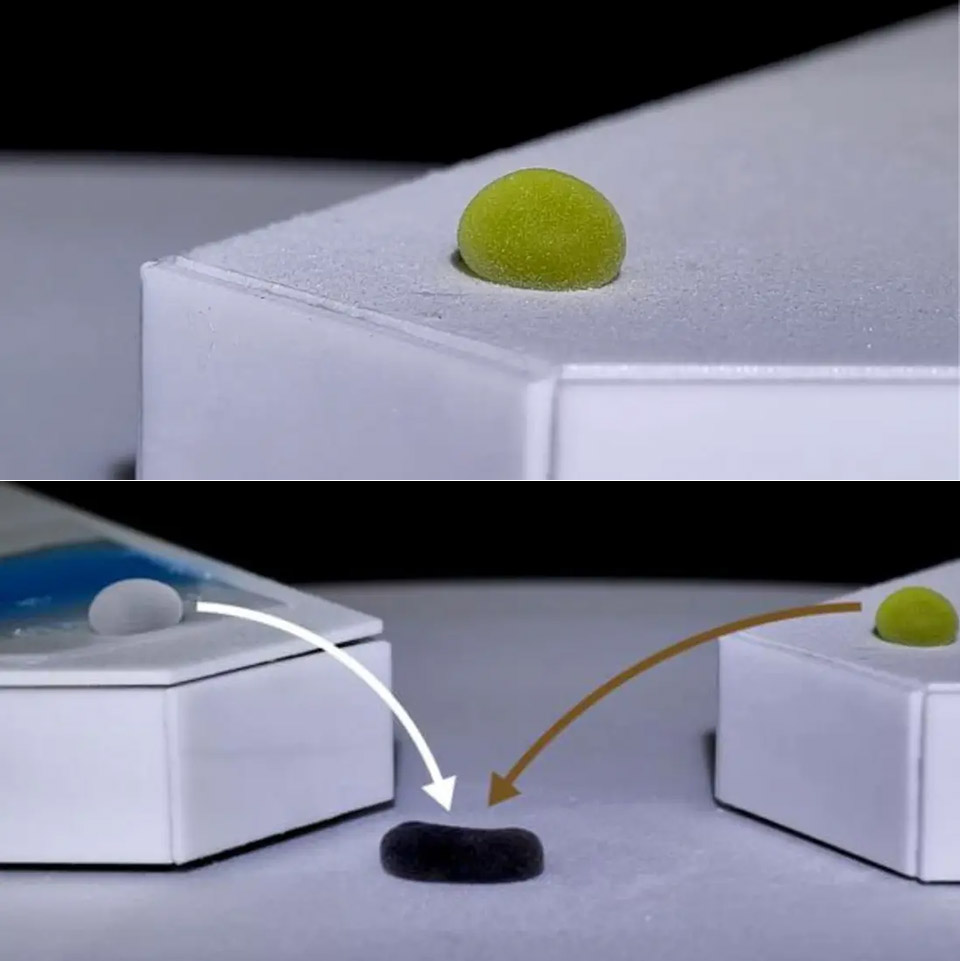
Photo credit: Jeon et al., Sci. Adv. 11, eadt5888 (2025)
A lab in Seoul had a major breakthrough with a project that produced a robot that resembles a gummy bear and behaves like a living cell. Just try dropping it from a table to see what happens – it splats and then just rolls away like it never happened. Squeeze it between your fingers and it oozes like jelly, only to snap back to its original shape when you let go. Play a burst of sound at it by sending two of them towards each other and they basically kiss, fuse and transform into one bigger blob – complete with whatever each one swallowed along the way.
They’ve been dubbed the first robots constructed almost completely of water. Every one begins as a perfectly formed ice cube little longer than a fingernail in length. The engineers then sprinkle the cube with Teflon flakes that are the size of salt grains. As the ice melts, the Teflon flakes form a waterproof skin that prevents any drops from escaping. The finished robot weighs less than a paper clip and costs around one penny.

Haribo 65W GaN Wall Charger, PD & QC 3.0 Fast Charging Block, 3-Port USB-C/USB-A Adapter, Gummy Bear…
- [Protection system] Equipped with a smart IC chip to protect the device from overcharging, overheating, and overpowering, the device is safe and…
- [Simultaneous charge] It can charge up to 3 devices simultaneously, allowing you to save time by charging different devices at the same time
- [Fast charging] It supports stable QC 4+/4.0 quick charging and max 65W PD 3.0 charging output. Charges various electronic devices quickly and…
Set one on a puddle of water and it floats just like a beetle. Try nudging it gently with a 24 kilohertz hum from an off the shelf ultrasound wand and it zips across the surface faster than you can wipe your finger across the surface. Tilt the wand and the robot starts to walk up the pool wall, leaps onto dry land and just keeps right on rolling – no wet footprints left behind.
When placed in a pool of water, it floats much like a beetle does. Try lightly prodding it with a 24 kilohertz hum from an off-the-shelf ultrasound wand, and it will glide across the surface faster than you can wipe your finger across it. Tilt the wand, and the robot begins to stroll up the pool wall, leaps onto dry land, and continues to roll without leaving any wet footprints.
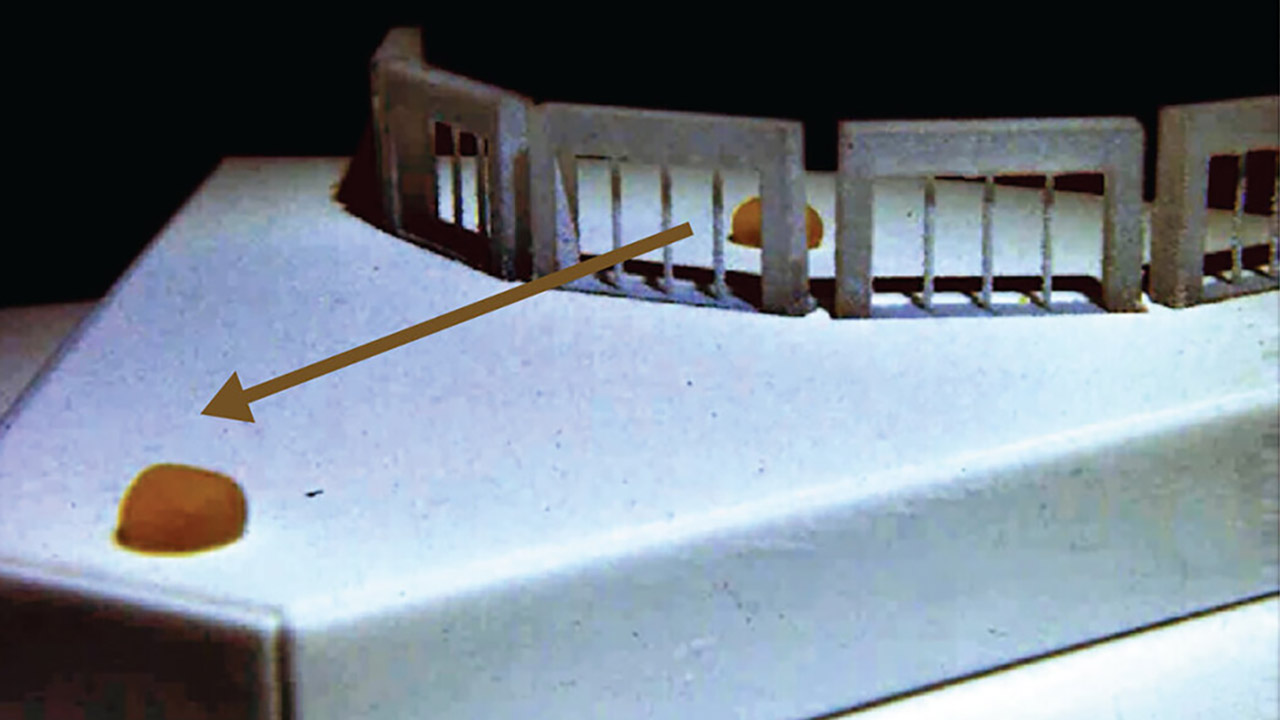
Consider a barrier with gaps half the robot’s width; any conventional solid stone would just bounce straight off. A single water droplet would essentially smear and stick. The Teflon robot, on the other hand, simply splits along the middle, threads both pieces through a separate gap, and then fuses back together on the other side, much like the T-1000 from Terminator 2. Only this one performs everything at room temperature, without the requirement for liquid metal.
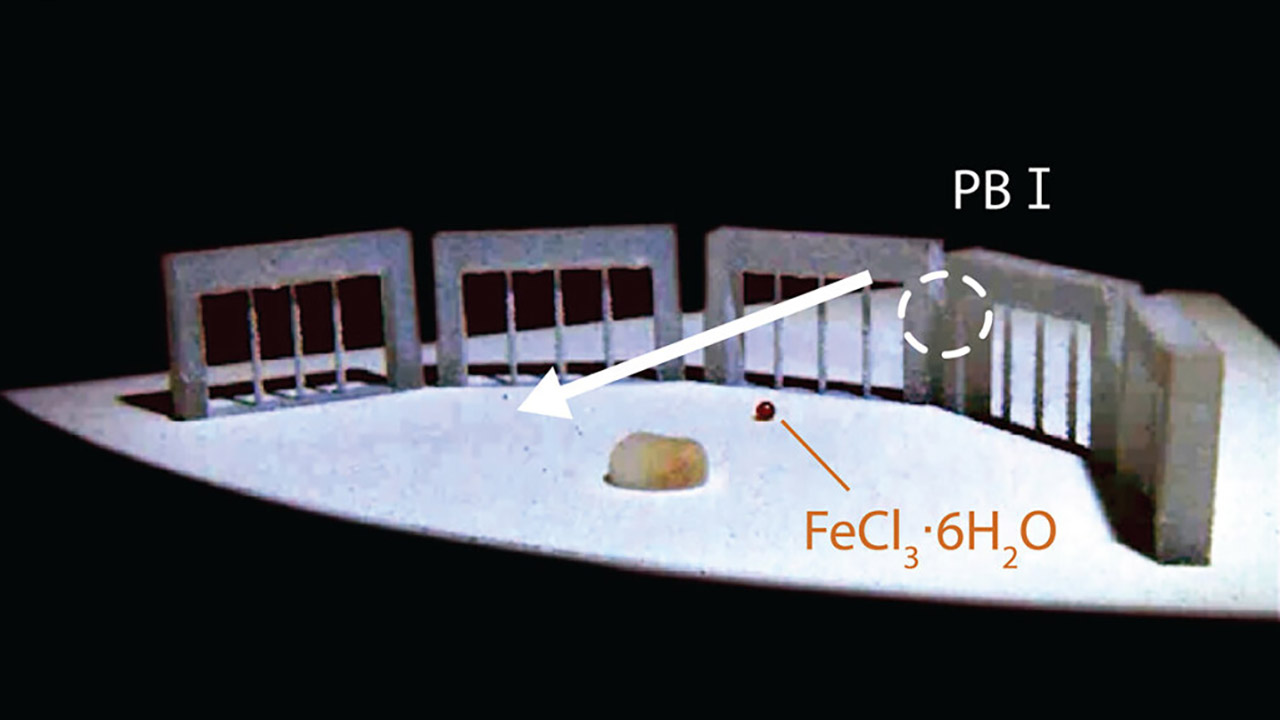
Give one a roll over a glass bead, and the skin will only open long enough for the bead to slip inside before sealing back up. Repeat the process with a grain of rust-colored iron salt, and the robot will turn a magnificent sunset orange. Give it another robot that has a clear crystal antidote, then fuse the two together, and the resulting blob will flash a magnificent blood red as the chemicals mix inside a private mini-reactor about the size of a raindrop.
The engineers created a small cliff that is thirteen millimeters tall, ten times the height of the robot. They then pushed two laden robots down the edge, watched as they hit on the floor, flattened out like pancakes, and then, without spilling a single molecule, stood back up and combined into one large blob. This is very different from how liquid robots used to act when they hit the ground and burst apart. These ones simply shrug and keep going.
They did not require any wires, batteries, or magnets to function. You only need a handheld ultrasound probe held two inches above the table to get them moving. Move the probe, and the robot will follow. Lower it, and the robot simply stops. However, if you put the probe straight down at two robots, they will flatten and weld into one. The louder the ultrasonic probe buzzes, the faster they move – up to six body lengths per second.
Under a microscope, the skin resembles dragon scales fashioned from breakfast cereal. Each flake covers the next, packed so tightly that water pressure alone cannot separate them. When the robot expands, the scales move past each other rather than shattering. When it shrinks, they pack more tightly. The armor is self-healing since the flakes are always floating on the water’s surface.
Old liquid robots started as perfect spheres—the shape with the least skin for the volume. That left too few flakes to go around. The Korean team flipped the recipe: start with a cube, which has fifty-five percent more surface area. Freeze it, coat it, melt it. The shrinking ice crams the flakes together until they form armor plate instead of a loose sweater.
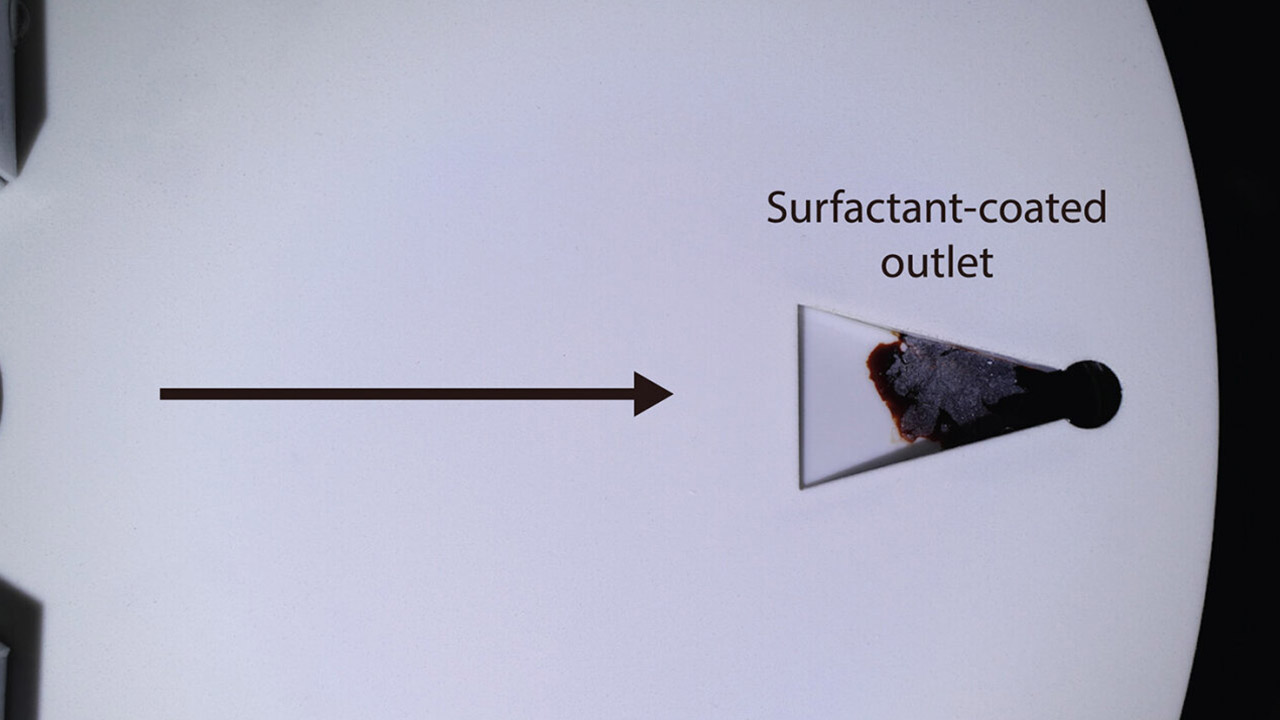
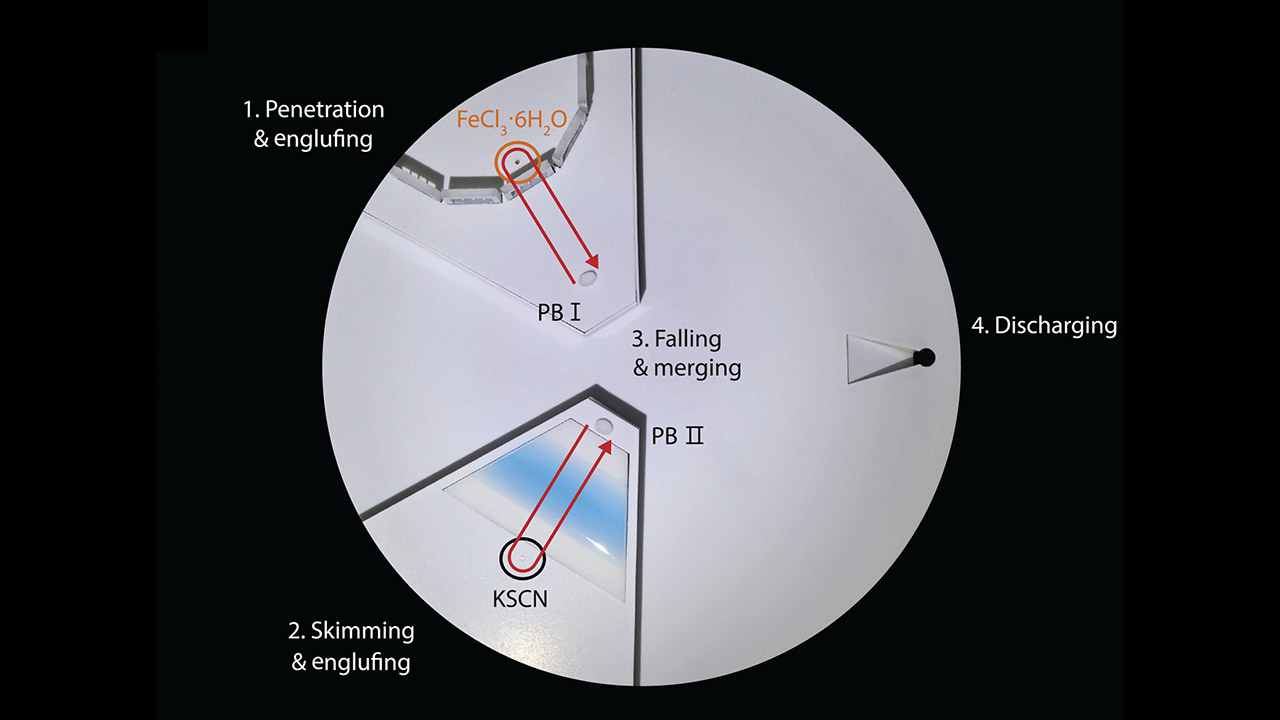
The researchers printed a dinner-plate arena with hills, jails, and a swimming pool. One robot jail-broke a yellow “toxin” pellet. Another swam the pool for the red antidote. Both jumped the cliff, merged mid-air, turned purple, then rolled to a drain. A single drop of soap on the drain cracked the armor and poured the neutralized waste into a vial below. Total time: forty-five seconds. Human fingers never touched the chemicals.
Send a thousand into a nuclear cooling pond to scrub radioactive dust. Drop a fleet down a clogged pipe to eat rust and flush themselves out. NASA is already asking whether a freezer on Mars could stamp out ice-cube robots to explore ice caves where wheels fear to tread.
[Source]
