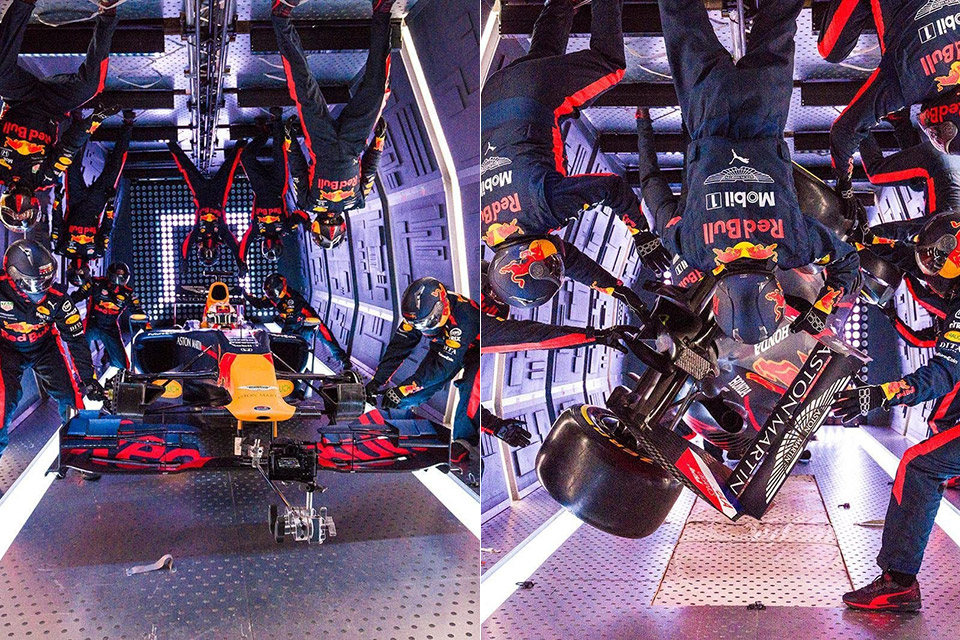
Photo credit: Red Bull Racing, Zero-G BTS stills by Denis Klero
By the end of the 2019 season, Red Bull Racing set numerous world records for fastest pit stops. However, as expected, the team was still eager to push itself to new heights, literally. They decided to put their skills to the test in a completely new setting, or more specifically, changing an F1 car’s four tires while floating around in the center of an aircraft.
They chose the 2005 RB1 chassis as their test car. Its narrower form and lightweight construction made it an ideal fit for the Ilyushin Il-76 MDK, a jet that typically conducts cosmonaut training and was receiving assistance from the Russian space program. The team arrived at the Yuri Gagarin Cosmonaut Training Center just outside Star City, where the flight plans had been finalized and they were ready to go. The pilots would climb the plane at a sharp angle to around 33,000 feet before cutting power just as they reached the crest of the arc, allowing the jet to glide downward in freefall. Inside the airplane cabin, those moments spent in freefall provided the team with a whooping 22 seconds of weightlessness, a brief wonderful period in which everyone drifted around freely. To acquire as much quality time in as possible, the crew squeezed in 7 flights and around 80 of these freefall arcs over the course of many days.
Sale

LEGO Speed Champions Oracle Red Bull Racing RB20 F1 Race Car Model Kits – Building Set for Adults, Ages…
- RED BULL CAR – LEGO Speed Champions Oracle Red Bull Racing RB20 F1 Race Car buildable model for Red Bull and Formula 1 fans
- AUTHENTIC DETAILS – This F1 race car features design details from the real-life 2024 version, including a rear wing, halo bar, and wider rear tires…
- F1 MINIFIGURE – The vehicle kit includes an F1 driver minifigure wearing a Red Bull outfit and a winged helmet to place inside the F1 race car’s…
You have to remember that time was of the essence here; weightlessness lasts only a little while, so every second counts. Once the team was in place and the equipment was ready to begin, the usable window of time was reduced to roughly 15 or 20 seconds. To make matters even more difficult, a mock-up of the complete apparatus was constructed on the ground so that everyone could acquire a feel for the movements before flying to the skies. Consider how much harder it will be if you are not tethered to the floor.
As expected, things did not go smoothly from the start. Finally, it came down to basic physics. On the ground, the mechanics would press against the floor to offset the twisting force of the wheel cannons, but in mid-air, the anchor was removed, causing the mechanics to spin around rather than turn the nut. Add in the possibility that stray tools or wheels would float away and disrupt the following phase, and you have a formula for disaster.
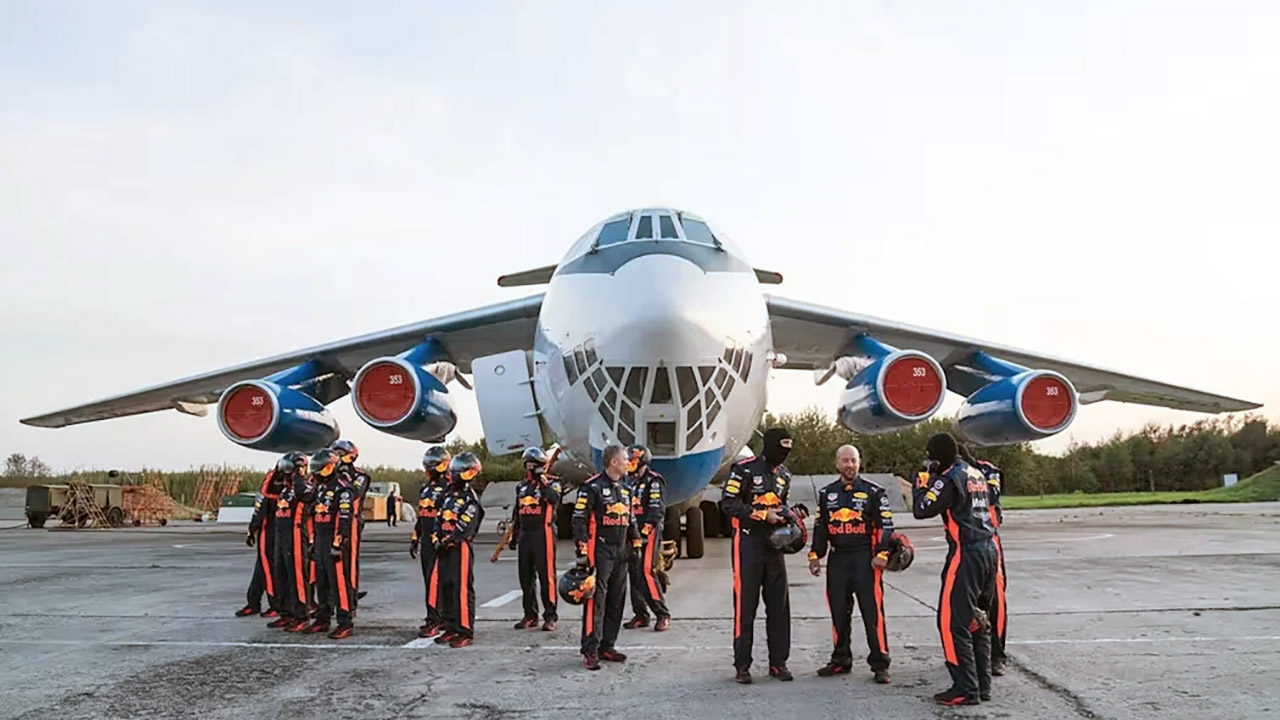
Photo credit: Denis Klero
It didn’t take long for the team to realize that the only way to make this work was to divide their crew and have half of them work on the car from underneath while the other half worked from what seemed like the ceiling. The car would be inverted relative to half of the group, resulting in a balance of pushes and pulls. The only thing holding them down were their footstraps, so the mechanics had to flex their ankles to stay in place.
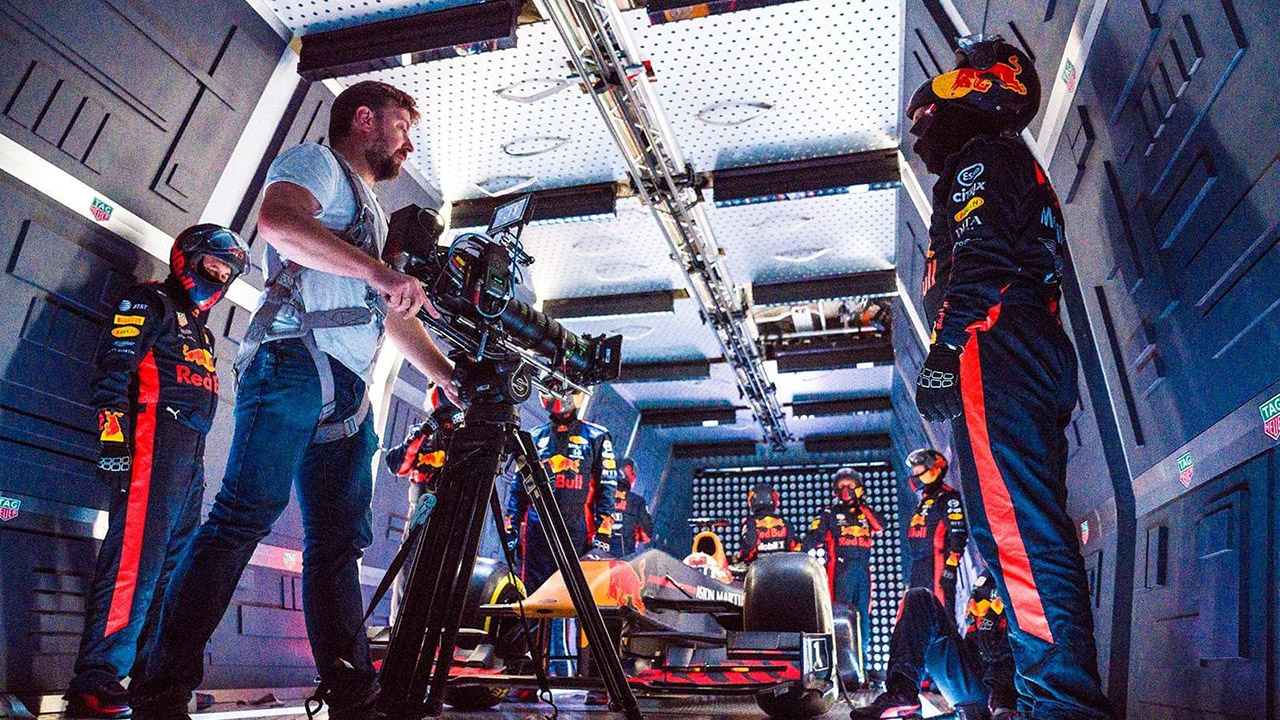
Photo credit: Denis Klero
The execution was completed in a relatively short period of time, with 16 crew members moving into predetermined places near the car, all of which were connected to a bespoke frame built to endure the severe ascent forces and float phases. They’d operate in a planned sequence, loosening the old nuts with the wheel guns before pulling the tires off and slipping the new ones in. To avoid spinning anyone out of control, the final tightening had to be steady and gentle. Every motion stayed choreographed or something would float out of reach.
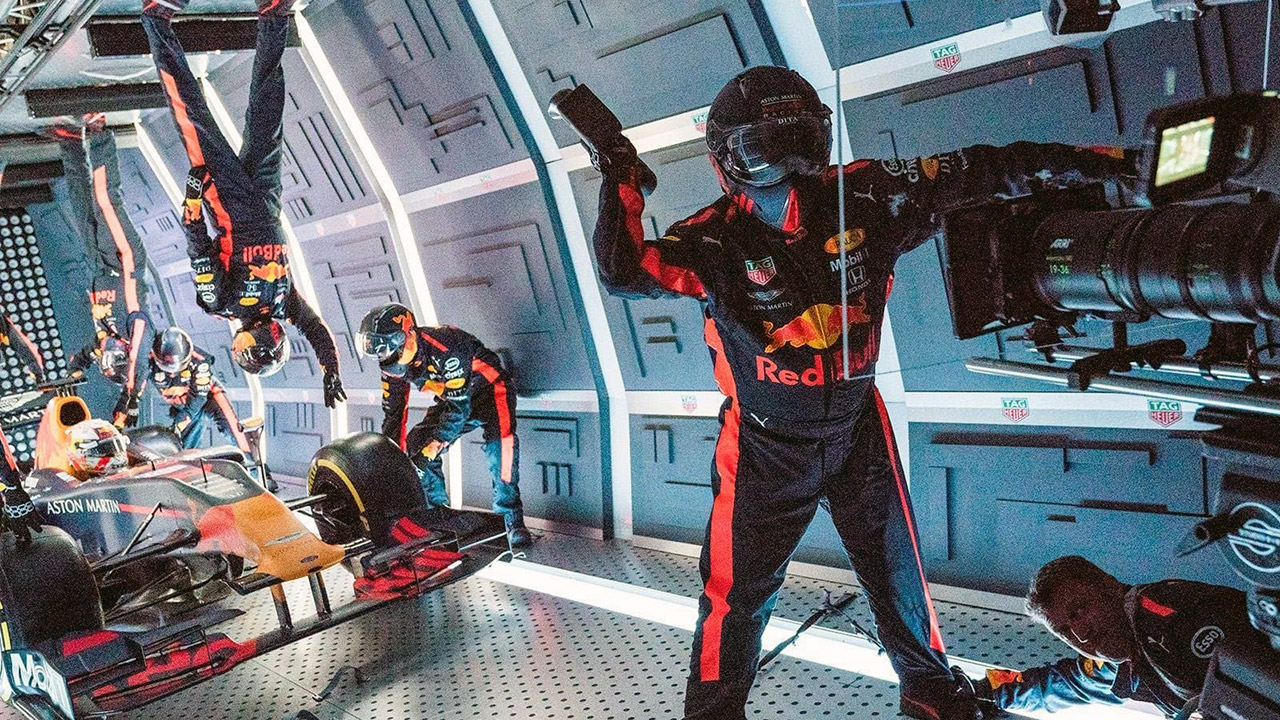
Photo credit: Denis Klero
In the end, they did it, completing a full tire change in about 20 seconds, a real world record in the middle of the air, and, as if you needed to be reminded, the timing was all spot on, with the sequence matching the exact order of a track pit stop, the only difference being the constant adjustments required due to the lack of weight.
[Source]
