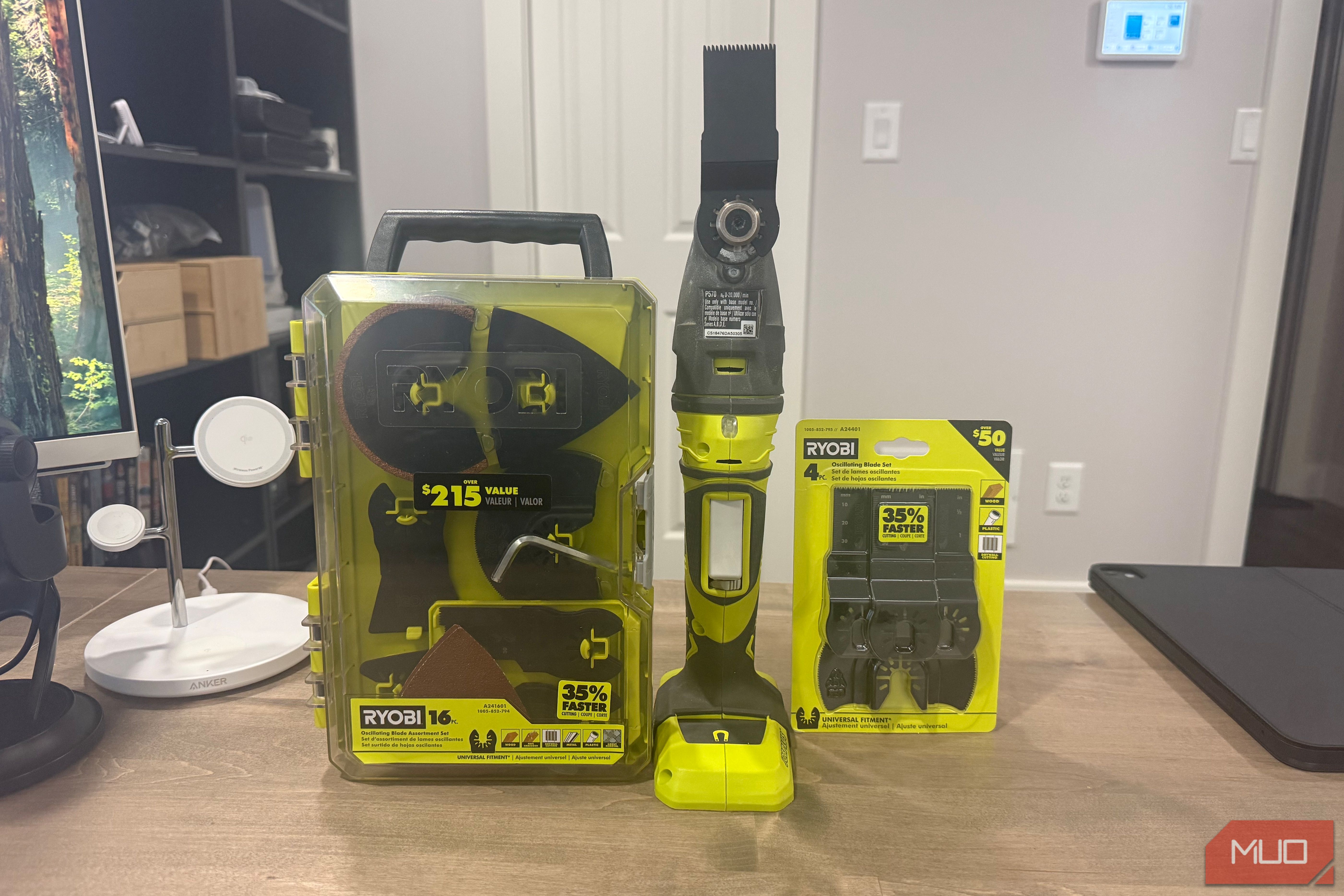
Most people use their oscillating tool for one job, then forget it exists. Mine sat in a drawer for months with my other Ryobi tools between projects — I’d grab it for a trim cut or to scrape old caulk, then put it back without thinking twice. That changed when I started working through the attachments in the RYOBI 20-piece oscillating multi-tool accessory set. Three of them, in particular, turned a tool I was barely using into one I reach for constantly. The set fits nearly every oscillating tool brand on the market, so whatever you’re running, these will work.
The plunge cut blade unlocks cuts nothing else can make
Flush against the floor, against the wall, wherever the saw can’t go
Last spring, I was patching a section of drywall mid-wall — not at a corner, not near a stud bay edge, just an awkward spot in the middle of a run. I needed a clean rectangular cut to pull out the damaged section and fit a backer board. A jigsaw needs an edge entry point, and drilling a starter hole and then chasing corners with it leaves a sloppy result. The plunge cut blade dropped straight into the surface and traced four clean lines in about a minute.
That narrow, straight-edged blade is built for situations where every other saw fails. It plunges into a surface to start the cut rather than entering from an edge, which opens up jobs like slotting wood near door frames, trimming blocking inside a cabinet, or undercutting a threshold without touching the surrounding material. The bi-metal construction in the RYOBI kit is what keeps it functional when it hits something unexpected — an embedded nail, a hidden staple — without destroying the blade on contact. Softer blades just fold.
Beyond drywall, I’ve used plunge cut blades to trim a window sill section that had softened from moisture, to open up a section of subfloor for a plumbing repair, and to cut access notches in tight spaces where nothing with a shoe plate could fit. None of those jobs had another clean solution.
Carbide-enhanced edge that chews through grout without touching the tile
Before I owned a grout blade, I tried removing deteriorating grout in my shower using a manual grout saw. An hour in, I had cleared maybe two feet of a single grout line, and my hand was done. The tiles looked untouched. I gave up and lived with the bad grout for another year.
The 1/16″ carbide-enhanced grout blade changes the math completely. The carbide grit on the cutting edge oscillates through grout fast enough that you’re making real progress in minutes, not hours. More importantly, the blade is thin enough to track the grout line without wandering into the tile face — I’ve never chipped a tile using it, even on older, more fragile ceramic. Once the grout is out, the channel is clean and ready for new material.
There’s more utility here than just regrouting. I’ve used the grout blade to clean out old, crumbling lines before they became a water infiltration problem, to prep a shower floor for fresh caulk at the wall-to-floor joint, and to remove hardened tile adhesive from a backsplash repair. The carbide construction holds up through all of it without the edge degrading the way a standard steel blade would. If you own an oscillating tool and do any tile work at all, this blade is non-negotiable — it’s the kind of attachment that earns its place the same way the Ryobi tools that prove the brand wrong do.
The triangular sandpaper attachment reaches every corner your orbital misses
60, 120, and 240 grit — from rough shaping to a finish-ready surface
I was refinishing a set of painted window frames last fall — stripping back layers of old paint to bare wood before repainting. The orbital sander handled the flat faces in minutes. Then it was useless. Every corner where two pieces of casing met, every return where the frame met the wall, required going back in by hand with a sanding block. It was slow, inconsistent, and tedious enough that I started cutting corners on prep.
The triangular sandpaper pad solves that problem because the pointed tip is designed specifically to fit into 90-degree corners — window frames, baseboard returns, cabinet corners, the tight angle where a stair tread meets a riser. The oscillating motion is also gentler than rotary, which matters in detail work. An orbital moving aggressively in a tight spot can dig into surrounding wood; the triangular pad keeps more control in your hands.
The kit includes three grits: 60, 120, and 240. That range covers rough material removal, blending, and final prep before finish — you can work through all three without swapping to a different tool. Aluminum oxide construction gives the sheets decent durability; they don’t gum up as fast under heat and friction as cheaper sandpaper does. I’ve used this on painted wood trim, raw hardwood, and metal brackets. For detail sanding in cramped spots, it’s become as reliable as my other Ryobi tools that consistently save me time in the workshop.
One kit, three jobs your other tools can’t finish
An oscillating tool without the right attachments is just a one-trick saw. These three — the plunge cut blade, the grout blade, and the triangular sandpaper pad — each open up a category of work that nothing else in a standard home shop handles as well. The RYOBI 20-piece kit runs around $71.94 and includes all of them, plus more to explore as you find new uses. Universal fitment means it works with Milwaukee, DeWalt, Makita, and most other brands. If your oscillating tool has been collecting dust between projects, this kit is the fastest way to change that.
