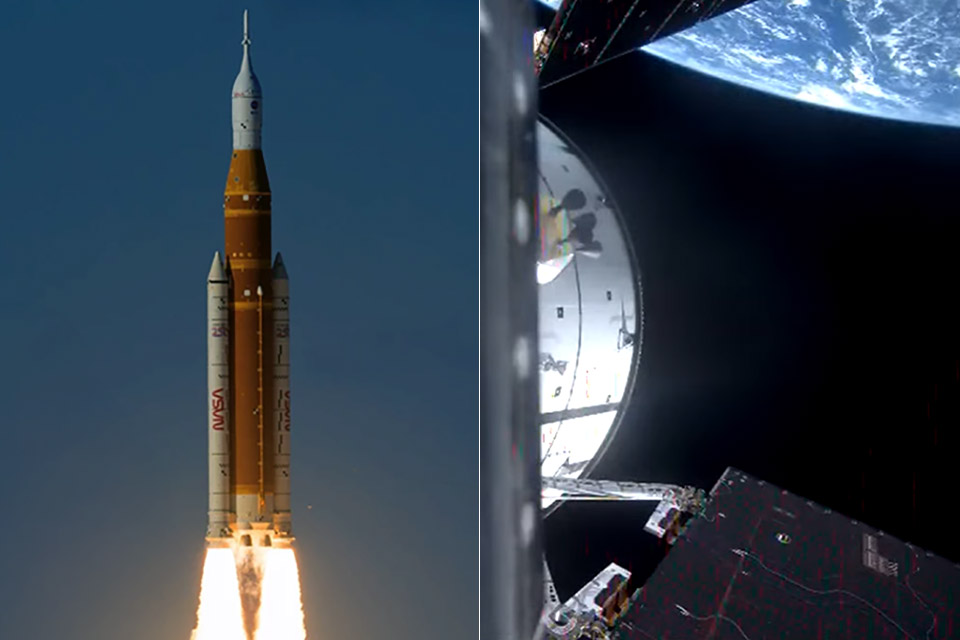
NASA’s Artemis II crew launched from Kennedy Space Center on time at 6:35 p.m. Eastern on April 1, 2026, the huge Space Launch System rocket completed its duty, carrying the Orion spacecraft Integrity away from Earth and passing Max Q without incident.
Reid Wiseman, a seasoned Navy veteran and former commander of the astronaut office, leads the expedition and has previous experience on the International Space Station. Victor Glover, another skilled Navy test pilot and ISS veteran, is in the copilot’s seat; he is also about to make history by becoming the first black astronaut to reach the far side of the Moon. Christina Koch, an electrical engineer with an excellent resume, is the mission specialist on board; she still maintains the record for the longest solo spaceflight by a woman, at an incredible 328 days. Joining the NASA crew is Jeremy Hansen from the Canadian Space Agency, the first person from outside the United States to be sent beyond low Earth orbit.

LEGO Technic NASA Artemis Space Launch System Rocket Building Toy for Boys & Girls – STEM Learning…
- BUILD AN OFFICIAL NASA ROCKET – Kids prepare to explore outer space with the LEGO Technic NASA Artemis Space Launch System Rocket (42221) building…
- 3-STAGE ROCKET SEPARATION – Young builders can turn the hand crank to watch the rocket separate in 3 distinct stages: solid rocket boosters, core…
- STEM BUILDING TOY FOR KIDS – This educational rocket kit was created in collaboration with NASA and ESA to showcase the authentic system that will…
As you’d expect from a seasoned crew, the first few hours after liftoff were pretty routine. The team performed all of the standard system checks and confirmed that the solar panels were generating power as expected. There was only one little hiccup: a fault light illuminated during the toilet checkout, which ground control and the crew swiftly resolved, and the rest of the mission went smoothly.
The flight controllers performed an apogee lift burn to place the spacecraft in the proper position for the next phase of the mission, and the crew is now preparing for a proximity operations demonstration. Over the course of around 70 minutes, Orion will pull back from the upper stage, do a fast loop around, and then the crew will take manual control and gently guide the spacecraft towards it. They are collecting handling data to help develop navigation systems for future missions that will operate near the Moon without the use of GPS.
The entire operation will take around 10 days, from launch to splashdown in the Pacific. After finishing their task in Earth orbit, the crew will initiate the translunar injection burn, which will send them to the Moon. Then, on April 6th, they’ll fly over, getting close enough to the far side to view it for themselves. Before Orion returns home, its instruments will collect data on the lunar surface, the radiation environment, and the effects of deep space on the human body.
