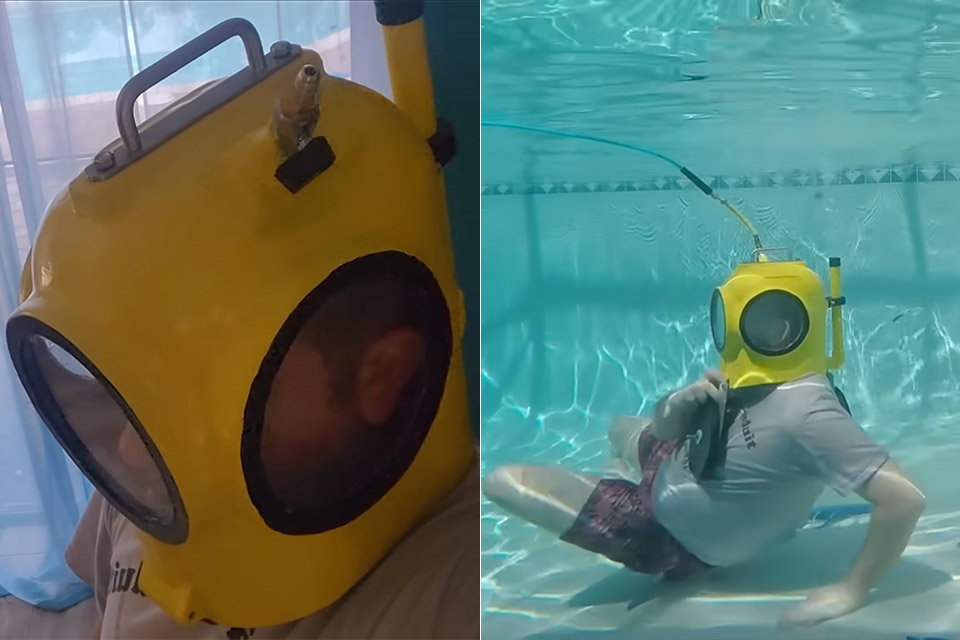
Maker Hyperspace Pirate has created a dive helmet using a 3D printer, tons of fiberglass, and a lot of ingenuity. They transformed an old diving concept into something that works, at least for shallow pool diving. This helmet is modeled like old surface-supplied diving gear. Air rushes in from above and exhaust leaves from below, keeping the diver’s head dry inside a little upside-down plastic bubble.
This project demands precise measurements, so Hyperspace Pirate originally sketched up the dimensions of the helmet on cardboard: 7.5 inches wide, 9.75 inches deep, and 11.25 inches high. Then Onshape software was used to generate a digital model of the object. It was divided into four separate components to accommodate the maker’s 3D printer, a Prusa MK3S, and manufactured with varying layer thicknesses to balance speed and strength. The printer used ABS filament, and after printing, the components were bonded together and encased in fiberglass soaked in epoxy for added strength. He had to be cautious about the sort of resin used because the other type tends to attack the ABS pieces.

Bambu Lab A1 3D Printer, Support Multi-Color 3D Printing, High Speed & Precision, Full-Auto Calibration…
- High-Speed Precision: Experience unparalleled speed and precision with the Bambu Lab A1 3D Printer. With an impressive acceleration of 10,000 mm/s…
- Multi-Color Printing with AMS lite: Unlock your creativity with vibrant and multi-colored 3D prints. The Bambu Lab A1 3D printers make multi-color…
- Full-Auto Calibration: Say goodbye to manual calibration hassles. The A1 3D printer takes care of all the calibration processes automatically…
Three large transparent acrylic panes, one in the front and one on each side, provide visibility and are press-fitted into position and sealed with silicone caulk. The weight of the water at deep forces the windows in and closes them securely. A carry handle on top allows you to move the item about, and there are some useful small fittings for installing lighting or a camera.

Air enters through a small SAE fitting on the top of the helmet, which has a check valve to prevent air from flowing back in if the supply fails. Any extra air leaves at the back through a long, hollow PVC pipe, resulting in constant bubbles. The air supply is handled by a quiet oilless compressor, the MAC100Q type, which produces a consistent 40 liters per minute at up to 2 bar of pressure. This allows us to dive down to approximately 10 meters (33 feet) without running out of air. The rig is powered by a 12-volt, 35 amp-hour lead-acid battery connected to a 2 kilowatt pure sine wave inverter. It’s all mounted on a pool inner tube float, with a flat piece of plywood for stability and a handy diver-down flag.

Ballast weights, which are positioned on either side and held in place by a pair of large steel plates, work to keep the helmet underwater. We began with 30 pounds of weights, but after a few initial tests, we added an additional 10 pounds to achieve neutral buoyancy. A neoprene pad protects the neck against pressure points.

The helmet got a good workout in the pool, with dry runs ensuring proper fit and airflow, and underwater sessions allowing the builder to move around. We’ve had to be careful not to go too deep, partly because the bottom of the pool is a little uneven, but the airflow keeps it nice and cool and dry inside, preventing the windows from fogging or overheating. The compressor ran smoothly, and we were relieved that the helmet did not overheat. There was one peculiarity, however: the exhaust pipe would occasionally give out a small gurgling. It was a little unpleasant at the time, but it turned out to be harmless.

Safety has always been a key priority here, which is why the oilless compressor is a must-have. It means there is no risk of oil vapor or exhaust fumes entering the helmet. And just in case something goes wrong, we have a check valve to prevent the air pressure from decreasing quickly. Despite the fact that the helmet works extremely well for shallow water tasks, Hyperspace Pirate is quick to point out that this is still very much an experimental project, and it is not safe to use in open water or much deeper water without some serious modifications to make it waterproof, as well as a bit of backup air to be safe.
[Source]
