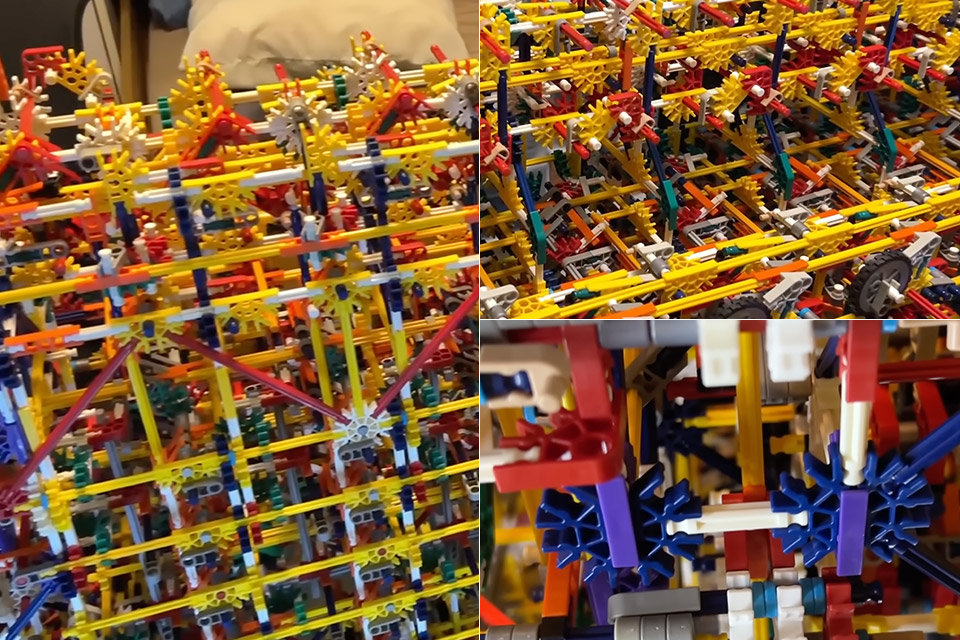
In a world of silicon and circuits, Shadowman39 is building a new kind of computer: one made entirely of Knex, the colorful plastic construction toy some may remember from their childhood. His latest video reveals a mesmerizing step forward in his 8-bit mechanical computer project.
Shadowman39’s computer is 8-bit, which means it processes data in chunks of 8 binary digits, or bits. These bits can represent numbers from 0 to 255 or, with two’s complement, signed integers from -128 to 127. This update is all about the registers and RAM, which are the machine’s memory and data staging areas. Registers are temporary storage units that hold numbers the arithmetic logic unit (ALU) will process. The system has three registers: two main ones, A and B, and a sum register that holds the ALU output. Each register holds an 8-bit value using levers that physically represent 1s and 0s (pushed one way for a 1 and the other for a 0). To debug, Shadowman39 can manually flip these levers, but in full operation, the computer automates everything and runs programs without human intervention.
Sale

K’NEX – 100 Model Building Set ‚ 863 Pieces, STEM Building, Kid Construction Set‚ Ages 7+
- Classic Pieces: This set comes with 863 classic K’NEX rods and connectors. These pieces can be attached to one another in different ways. It allows…
- Real Moving Parts: Unlike other building toys, K’NEX allows kids to create unique models that actually move. Kids can make interactive toys using…
- Convenient Storage: With over 860 pieces, K’NEX presents the 100 Model Building Set in a hassle-free portable suitcase storage box. You don’t need…
RAM, or random-access memory, is like registers but on a larger scale. Shadowman39 has built two 8-bit RAM modules and plans to stack up to eight. These modules store bits using a flip-flop method, where a physical component toggles between two positions to represent 1 or 0. The RAM and registers are similar but not identical; Shadowman39 notes the RAM uses a 5th generation design that simplifies data operations compared to the register versions.
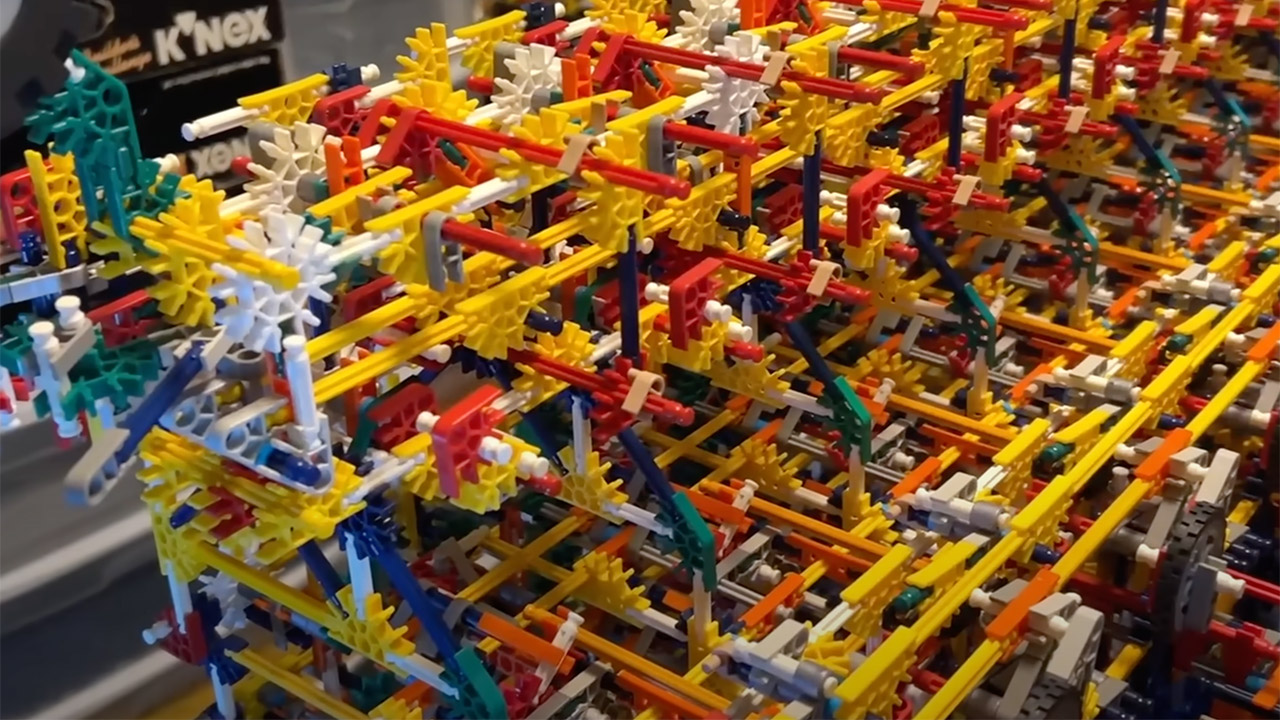
A data bus – eight vertical rods along the length of the computer – is the conduit for 8-bit values to be transferred between RAM, registers and other components like the ALU. To read data, a register or RAM module pushes its stored bits onto the bus, raises the rods for 1s and lowers them for 0s. To write data, the destination register or RAM reads the bus and adjusts the rods accordingly. The operation is powered by two motors, one for reading and one for writing, each turning a crank that completes a 360 degree cycle in about 3 seconds. These motors are connected by gears so the timing is accurate, with the write action slightly delayed after the read to avoid data conflicts.

Choosing which register / RAM to read from or write to, requires a clever system of mechanical pickers. For the registers, a simple swivel linkage selects A, B, or the sum register, but the RAM requires a more complex solution. Shadowman39 uses a 4-to-16 selector, a mechanical decoder that uses 4 input bits to select one of 16 outputs, even though only 8 are needed for the proposed RAM stack. Each output corresponds to a specific RAM module and the selector is set up so only one is active at a time. By changing the input bits to binary values (e.g. 0001 for the second RAM slot), the selector physically contacts the desired module and allows for exact data access. The counterweights on the selector are staggered to fit within the narrow vertical space of each RAM module, a practical solution to Knex’s physical constraints.
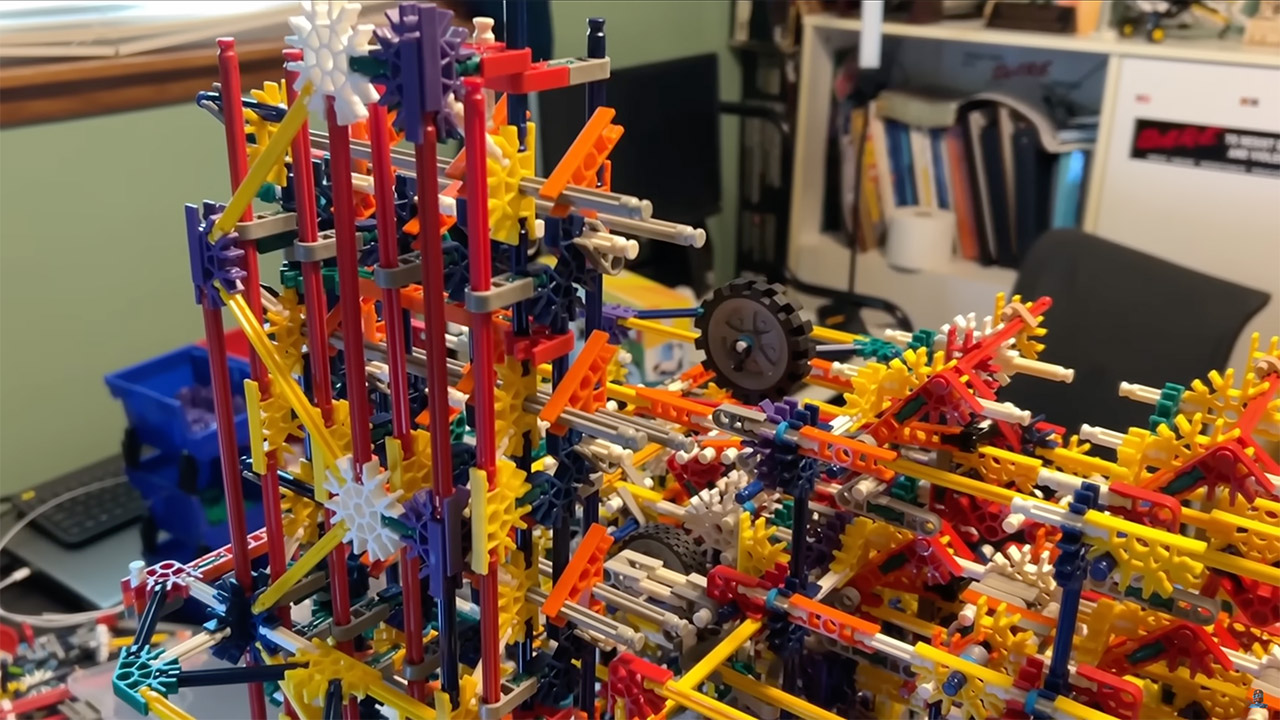
Automation ties everything together and makes the computer a self operating machine. The read and write motors at the bottom of the computer are always spinning but only engage when needed thanks to a clutch-like transmission arrangement. The control lines that Shadowman39 currently sets by hand will be replaced in the future by instructions stored in read-only memory (ROM) which will sit alongside the RAM and send commands to the system. The ROM is still being built and will have a similar design to the RAM but without write capabilities it will only read pre-set instructions to the bus. This will allow the computer to run programs, making it a fully programmable machine.
